

The Under-Eye on GLP-1: Why Hydrogel Helps When Volume Has Shifted
A focused, empathetic guide to the periorbital area during rapid weight change — and how the Reformer Under Eye Mask sits inside a thoughtful response.
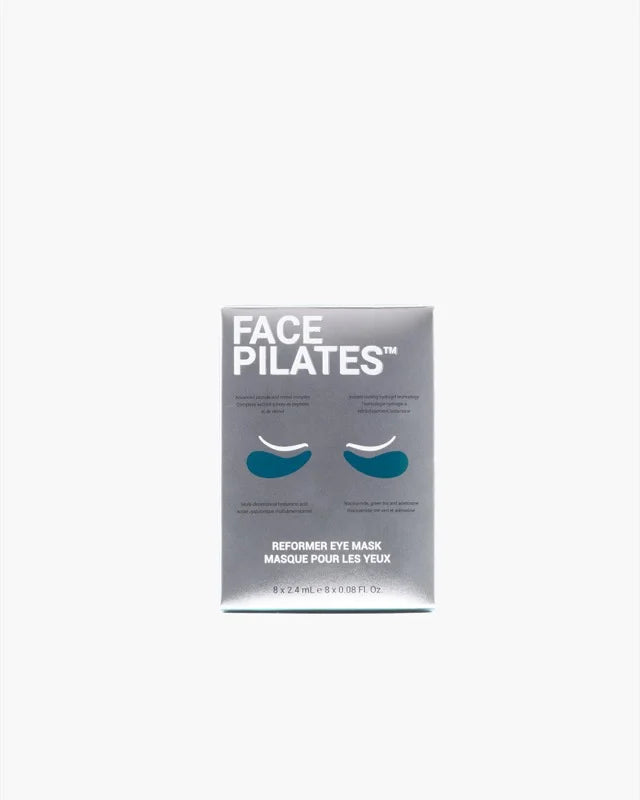
The periorbital region is, on most faces, the area most sensitive to body change. The skin there is half as thick as the cheek, the orbital fat pad sits very close to the surface, and the microvasculature responds quickly to anything happening systemically — including the rapid weight loss many people experience on GLP-1 medications such as semaglutide and tirzepatide. This article addresses that area specifically: what changes, what to use, and why the hydrogel format of the Reformer Under Eye Mask by Face Pilates™ is well-matched to a moment of body change.
What changes around the eye during GLP-1 use
Three things tend to register first. The orbital fat pad thins along with the rest of the body's adipose tissue, which can deepen the tear-trough and increase the visible shadow under the eye. The skin of the eyelid and the periorbital region, which had been stretched around larger volume, does not always retract perfectly, producing mild laxity that becomes visible particularly in side-lit photography. Hydration drops because GLP-1 medications often reduce overall fluid intake; the under-eye registers dehydration faster than any other facial subunit. None of these is a failure of the body. All of them are responses to a fast change.
Why hydrogel is the appropriate format here
A hydrogel patch is a polymer lattice that holds water within its structure, conforms to the orbital bone, and releases its active ingredients gradually over fifteen to twenty minutes of wear. For a periorbital area in flux, this format is well-matched on three engineering dimensions. First, the substrate is cool — applied from the refrigerator, it produces immediate vasoconstriction, reducing the bluish tint that the deepening tear-trough now casts. Second, the lattice forms an occlusive seal that raises the local hydration gradient and counters the systemic dehydration the medication tends to produce. Third, the actives are released gradually, allowing the orbital tissue to absorb a sustained dose rather than a single saturation. The five actives in the Reformer Under Eye Mask — glycerin, betaine, trehalose, sodium hyaluronate, and panthenol — are all water-soluble humectants and barrier-repair ingredients, which is the profile dermatologists prefer for sensitive periorbital skin in a period of change.
The under-eye area registers body change first. It also responds first when the right work is done with care.
The topical pairings that matter
Three topical companions to the Reformer Under Eye Mask deserve consideration. A caffeine-based eye serum used daily — SkinCeuticals AOX+ Eye Gel, Drunk Elephant C-Tango, Olaplex No.9 Eye Cream — produces a small but consistent reduction in vascular shadowing across four to eight weeks of consistent use. A peptide eye cream — Olaplex No.9, Drunk Elephant Wonderwild, Medik8 Crystal Retinal Eye — supports the dermal matrix that has been working hard. A gentle ceramide-rich barrier moisturiser — La Roche-Posay Toleriane Double Repair, CeraVe Eye Repair, Dr. Jart+ Ceramidin — reinforces the lipid layer that supports the periorbital seal at night. Each pairs with the mask in the same way: the mask delivers the high-dose finishing step, the daily products maintain the work in between.
The supplements that support the eye area specifically
Three supplements have evidence worth taking seriously for periorbital skin during GLP-1 use. Hyaluronic acid taken orally at one hundred and twenty to two hundred and forty milligrams daily produces measurable skin hydration improvements across twelve weeks — particularly relevant when the medication itself is reducing fluid intake. Lutein and zeaxanthin at ten and two milligrams respectively support macular health and have small but consistent evidence for reducing periorbital strain and improving skin tone around the eye. Marine collagen peptides at fifteen grams daily support skin elasticity, which becomes more consequential as the dermis adjusts to the body's new contour. A fourth — astaxanthin at six to twelve milligrams daily, from microalgal sources — supports skin elasticity and produces the warm carotenoid tone that compensates for some of the cool shadowing that develops in the orbital region during weight loss. None of these matter in a week; all of them compound across months.
What to pair with the Reformer Under Eye Mask while on a GLP-1 medication: a daily caffeine eye serum (SkinCeuticals AOX+, Drunk Elephant C-Tango, Olaplex No.9); a peptide eye cream layered above; a ceramide-rich barrier moisturiser at night (La Roche-Posay Toleriane Double Repair, Dr. Jart+ Ceramidin); a four-supplement compound — oral hyaluronic acid, lutein/zeaxanthin, marine collagen peptides, astaxanthin — built across eight to twelve weeks; and a deliberate increase in daily water intake, which the medication itself tends to suppress.
When in-clinic care can address what the topical layer cannot
The most consequential periorbital changes during GLP-1 use are structural — orbital fat thinning and the resulting tear-trough deepening — and these do not resolve with topical care alone. For readers within reach of a board-certified dermatologist, two options deserve a clinical conversation, once weight has been stable for three to six months. Hyaluronic acid filler placed conservatively in the tear-trough by an injector experienced in the post-weight-loss face can restore visible contour. Collagen-stimulating injectables such as Sculptra placed at the midface can address the broader volume change that the orbital area is responding to. Both are durable, both have risks, and both should be undertaken only with a clinician who has seen many post-weight-loss faces. The Reformer Under Eye Mask, used the night after any procedure, supports the recovery with its post-procedure-appropriate profile.
The periorbital area is the part of the face most sensitive to body change, and the part that responds first to the right work. Use the Reformer Under Eye Mask twice a week, plus the morning of any moment that matters. Layer in a caffeine eye serum daily, a peptide eye cream, and a ceramide moisturiser at night. Build the supplement compound — oral hyaluronic acid, lutein and zeaxanthin, marine collagen, astaxanthin — across eight to twelve weeks. Drink more water than the medication leaves you wanting. And when weight has been stable for three to six months, have the conversation with a dermatologist about whether the structural layer needs anything more. The face does not need to be apologised for; it needs to be supported, deliberately and with care.
Considered questions
Does GLP-1 medication cause dark circles?
Indirectly. The rapid weight loss deepens the tear-trough by thinning the orbital fat pad, and the medication's effect on fluid intake produces visible dehydration of the periorbital skin. Both register as deeper shadowing under the eye.
How often should I use the Reformer Under Eye Mask during weight loss?
Twice a week as a maintenance ritual is sustainable for most skin. More frequent use during weight-loss months — three times a week — is appropriate if the orbital region is showing visible change. Discontinue to twice a week once weight stabilises.
Should I wait for stable weight before considering filler under the eye?
Yes. Tear-trough filler in a moving contour produces unpredictable results. Wait three to six months of weight stability and consult a board-certified dermatologist experienced with the post-weight-loss face.
Can I use caffeine eye serums while on GLP-1 medication?
Yes. Caffeine in topical formulations does not interact systemically with GLP-1 medications. Introduce a single new eye serum at a time and discontinue if irritation occurs.
Which supplement is most consequential for the under-eye specifically?
Oral hyaluronic acid at 120–240 mg daily is the most directly relevant, given the systemic dehydration GLP-1 medications can cause. Lutein/zeaxanthin and marine collagen peptides compound the work across longer horizons.
What about cold-pressed cucumber or chamomile remedies?
These traditional remedies are gentle and may produce mild cooling but do not match the engineered effect of the hydrogel format. They can be used alongside the mask in the lead-up to an event without conflict.
Humbert R et al. — Facial changes in patients receiving GLP-1 receptor agonists (clinical review).
MDPI Cosmetics — Hydrogels in transdermal delivery and cosmetics (2025).
Pour Mohammad et al., Dermatologic Therapy — Systematic review of treatments for dark eye circles (2025).
Tomonobu R et al. — Astaxanthin for skin: clinical evaluation.
