
Learn About Face Pilates Treatments
The Face Pilates™ Treatment.
A seventy-five-minute, eight-step protocol developed by Thom Tullo, RMT, to support facial tissue health and function. By targeting all forty-three facial muscles, your fascia, your lymphatic system, and your circulation in a single session, Face Pilates does the slow, hands-on work that produces the kind of skin and structure that lasts.
One treatment. Every tissue of your face.
Face Pilates is a carefully curated, tool-intensive sequence of massage techniques designed to promote lymphatic drainage, increased circulation, decreased muscle tension, and improved tissue function across the entire face. Each step does work the others cannot. Together, they form an eight-step protocol that incorporates facial stretches, face and buccal massage, lymphatic drainage with gua sha and cupping, reflexology, contrast therapy with LED and ice globes, electronic muscle stimulation, and high-performance skin care as the conducting medium.
The treatment is performed by therapists trained in Thom Tullo's eight-step method at AMAN Spa in Toronto. It is not a facial, and it is not a single technique — it is a coordinated session that addresses the face as the complete structural and physiological system it is.
Yoga Ball Stretch.
Facial Stretch Therapy · 1 lb. Hand Pilates Ball
Every Face Pilates treatment opens with a stretch, just as every body workout opens with a warm-up. Using a one-pound hand Pilates ball, your therapist works the muscles of your face and the fascia surrounding them, gently lengthening tissue that has been held in patterns of expression, posture, and stress since the last session.
This is the facial stretch therapy phase of the protocol. It is short, deliberate, and unusual to feel for the first time — most people have never had their facial fascia mobilised before. The ball is sized and weighted specifically to allow controlled pressure across the cheek, the temporal region, and the jaw without straining the underlying structures.
What This Step Does
Facial fascia is the connective tissue web that surrounds and separates your facial muscles. Over time, it stiffens through repetitive expression (clenching, frowning, smiling under tension) and through adhesions that form between muscle groups that should slide independently. Warming and mobilising that fascia before deeper work improves how every subsequent step in the treatment lands. It is the single most overlooked phase in conventional facial work, and the reason Face Pilates produces sustained structural change rather than only surface change.
Face & Buccal Massage.
External Manual Work + Intraoral (Buccal) Release
Face and buccal massage is the deep manual phase of the treatment. Your therapist works the forty-three muscles of your face externally and then performs buccal release — an intraoral technique in which they work the masseter and lateral pterygoid muscles from inside the cheek, wearing medical-grade gloves. These are the deep chewing muscles, and they are also the muscles that hold the majority of the daily stress carried in your jaw.
The combined sequence breaks up scar tissue and the small fascial adhesions that form between facial muscles, releases held tension, restores muscle function, and increases the circulation that brings nutrients to the tissue. It is the phase of the treatment that produces the most visible release for clients carrying TMJ symptoms, tension headaches, jaw clenching, or stress lines around the brow and mouth.
Why Buccal Work Is Different
The masseter is, pound for pound, one of the strongest muscles in the body, and it is invisible from the outside. It cannot be reached effectively through the cheek skin. Buccal work approaches it from inside the mouth, where direct manual pressure can release the chronic shortening that produces a square jaw, a tight smile, and the dull headache that sets in after long meetings. Many clients describe this step as the moment they first realised how much tension they had been holding.
Facial Reflexology.
Pressure-Point Stimulation Of Facial Nerves And Tissues
Reflexology is the practice of applying controlled pressure to specific points on the face with the goal of stimulating the underlying nerve, vascular, and lymphatic networks. Your therapist uses dedicated facial reflexology tools — small, smooth, weighted instruments — to activate these points with precision the human fingertip alone cannot achieve.
The effect is twofold. The first is local: stimulation of circulation and lymphatic drainage in the immediate area, with the tools used to compound the muscle and fascia work performed in the previous step. The second is systemic: facial reflexology engages the parasympathetic nervous system, which is the branch of your autonomic nervous system responsible for rest, digestion, and tissue repair.
What Reflexology Adds To The Protocol
Most facial treatments rely on either manual pressure or topical actives, and stop there. Reflexology adds a third channel: targeted neural stimulation that produces deep relaxation in the body while delivering precise local circulation to the face. Clients commonly report that this is the step where they fall into the meditative state that makes the rest of the treatment most effective — relaxed muscles release more readily, and relaxed nervous systems absorb the work more deeply.
Lymphatic Drainage.
Manual Drainage · Gua Sha · Facial Cupping
The face contains a dense network of lymph nodes — the parotid group behind the jaw, the submandibular group beneath the chin, the cervical chain along the neck. These nodes are the drainage points your body uses to clear interstitial fluid, cellular waste, and the by-products of inflammation from the tissues of your face. When the lymph stagnates, the face holds water, looks puffy, and registers fatigue.
Lymphatic drainage in a Face Pilates session uses three coordinated techniques: hands-on manual drainage, gua sha (a flat jade or stone tool used with directional strokes), and facial cupping (small soft suction cups that draw stagnant fluid into the lymphatic pathways). Your therapist moves fluid from the central face outward to the major node clusters, and from there along the lymphatic chain back into your venous circulation.
The Visible Effect
Most clients see the effect of this step in the mirror immediately: a leaner jawline, a softer under-eye, a brighter complexion, and the disappearance of the morning puffiness that sets up most days. The deeper effect is on immune function. Your lymphatic system is part of how your body detects and clears infection, and moving lymph well supports immune surveillance in tissue that constantly faces environmental aggressors.
Contrast Therapy.
Red LED Light · Cryo-Globes
Contrast therapy alternates warming and cooling stimuli to drive circulation, reduce inflammation, and support cellular function. Face Pilates uses two coordinated tools: red LED light, applied across the face to deliver gentle warmth and photobiomodulation, and chilled glass cryo-globes, rolled across the same tissue to constrict surface vasculature and tighten the skin.
Red LED light in the 630–700 nanometre range has been studied for its effect on the mitochondria of skin cells. The wavelength stimulates the electron transport chain in those mitochondria, which in turn increases the cell's production of ATP — the same cellular energy currency the Reformer Face Mask was designed to support topically. More ATP means cells have the energy to repair, divide, build collagen, and renew themselves. It is the cellular foundation of the long-term changes Face Pilates produces.
The cryo-globes are the counter-balance. Glass spheres chilled to a controlled temperature are rolled methodically across the cheek, the brow, and the jaw, constricting surface vessels, calming the inflammatory response triggered by the deeper manual work earlier in the session, and tightening the skin's surface. The alternation between warm light and cold glass increases blood flow more than either alone, and finishes the session with the skin visibly toned and refreshed.
Why Contrast And Not One Or The Other
A single thermal stimulus produces a single physiological response. Alternation produces what physiologists call vascular pumping: vessels constrict under cold, dilate under warmth, and the rhythmic alternation moves more blood through the tissue than either intervention could on its own. The combined effect is greater circulation, faster recovery from the deeper massage work, and a visibly brighter, firmer complexion at the end of the treatment.
Luxury Skin Care.
Reformer Face Mask · Performance Serums
Face Pilates is a hands-on, tool-intensive treatment, which means it requires a medium — something that allows the tools to glide across the skin without friction and that conducts electrical current during the electronic muscle stimulation phase. Most spas use plain massage oil for the manual work and ultrasound gel for the electrical work. Both are functional. Neither does anything for the skin itself.
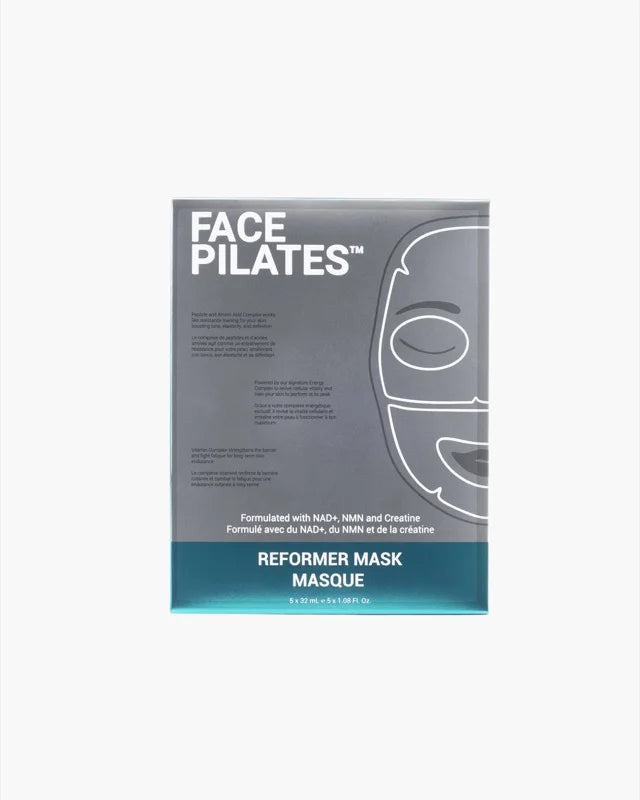
Face Pilates uses high-performance skin care as the medium instead. Your therapist applies the Reformer Face Mask, a biocellulose sheet engineered around the same cellular-energy science the rest of the treatment supports, alongside targeted serums chosen for your specific concerns. The mask conducts the electrical current of the EMS phase, the actives penetrate during the occlusive moments of the session, and the skin receives a dense delivery of NAD+, NMN, creatine, peptides, and humectants while the manual work is at its most effective.
Why The Medium Matters
Every minute of a 75-minute treatment is a minute the skin is open, warmed, and in contact with something. The choice of what is in contact with it is not a small one. By replacing the inert oils and gels that other clinics rely on with formulas designed to actively feed the tissue while the work is happening, Face Pilates compounds the effect of every other step. The treatment supports the masks. The masks support the treatment. The result is what most clients describe as the most considered facial protocol they have ever experienced.
Seventy-five minutes. Forty-three muscles.
The full Face Pilates treatment is available at AMAN Spa, 47 Colborne Street, in Toronto. Sessions are bookable through the spa’s online system. Note that the treatment cannot be performed within seven days of Botox or fourteen days of dermal filler, to prevent product migration.
If you would like more context.
The treatment exists inside a wider brand and a deeper body of skin science. These two pages are where to look next.
Thom Tullo, RMT
The full story of how a Registered Massage Therapist trained at Sutherland Chan built the Face Pilates method — and the spa, and the masks, that came out of it.
Read About Thom → The Collection · 15% Off BothThe Reformer Collection
The two masks that bring the treatment home, compared side by side. Save fifteen percent on the duo with code COMBINATION at checkout.
Compare The Masks →Skin science, in your inbox.
Get ten percent off your first order, plus the founder’s notes on what actually works in long-term skin health.
Use code WELCOME10 at checkout for 10% off your first order.