

The Science Of Skin Aging — Part Two Of Three
A face has a shape before it has a surface. Beneath the skin sits a framework: collagen and elastin for firmness and recoil, a layer of connective tissue called fascia that organises everything, and the facial muscles themselves. This second article in the series follows how that framework ages — how the body's protein-maintenance system falters, and how muscle and fascia stiffen, slacken and lose their easy glide. As before, each change is explained first in plain language and then in more depth, and each is followed by the Reformer mask ingredients studied alongside it. Here, more than anywhere, it is also followed by the Face Pilates treatment, which was built for precisely this layer.
The first article in this series looked inward, at the cell's interior — its energy, its DNA, its gene-expression settings. This one looks at architecture. The visible signs people most often describe as ageing — a softer jawline, a deeper fold, a face that seems to have descended a few millimetres — are rarely a problem of the skin alone. They are the skin reporting faithfully on a structure that has changed beneath it.
The loss of proteostasis
Your skin's structure is built from proteins — collagen for firmness, elastin for bounce. Ageing disrupts the system that maintains and renews them: production slows while the enzymes that break them down grow more active. The result is skin that loses its architecture — it thins, slackens, creases, and gives up the plumpness of youth.
Proteostasis is the word for a working, well-maintained set of proteins, and in ageing skin it is steadily compromised. Classic dermatology research found that skin collagen density declines by roughly one per cent per year through adult life. Production by dermal fibroblasts slows as the growth-factor signalling that prompts it (the TGF-β/Smad pathway) becomes less active; meanwhile a family of enzymes called matrix metalloproteinases — switched on by ultraviolet exposure and by the inflammatory signals of senescent cells — degrades existing collagen faster than it is replaced. Elastin is a separate matter again. It is among the longest-lived proteins in the human body, laid down chiefly before adulthood; adult skin produces very little new functional elastin, so its gradual fatigue, oxidation and stiffening are largely permanent. The realistic strategy, then, is to support the synthetic capacity that fibroblasts still have, to temper the enzymes that break matrix down, and to supply the peptide signals that prompt fresh synthesis.
In the Reformer Face Mask
Palmitoyl Pentapeptide-4 Centella Asiatica Ammonium Glycyrrhizate
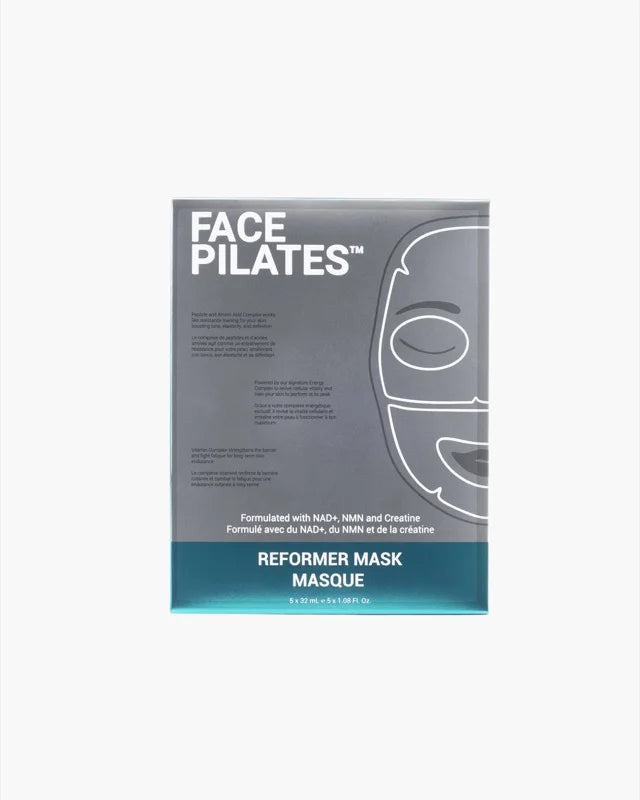
Palmitoyl Pentapeptide-4 — known in formulation as Matrixyl — is a lipopeptide designed to resemble the fragments released when collagen breaks down; in skin-cell research these matrikine signals are studied for prompting fibroblasts to build fresh matrix. Centella asiatica, rich in asiaticoside and madecassoside, has been shown in research to stimulate collagen synthesis through TGF-β/Smad-related signalling. Ammonium glycyrrhizate, drawn from licorice root, helps calm the inflammatory environment around the fibroblast. Together they sit within the Reformer Face Mask, formulated for skin that looks firmer and more even.
In the Reformer Under-Eye Mask
Hydrolyzed Collagen Retinol SYN-AKE Peptide Argireline
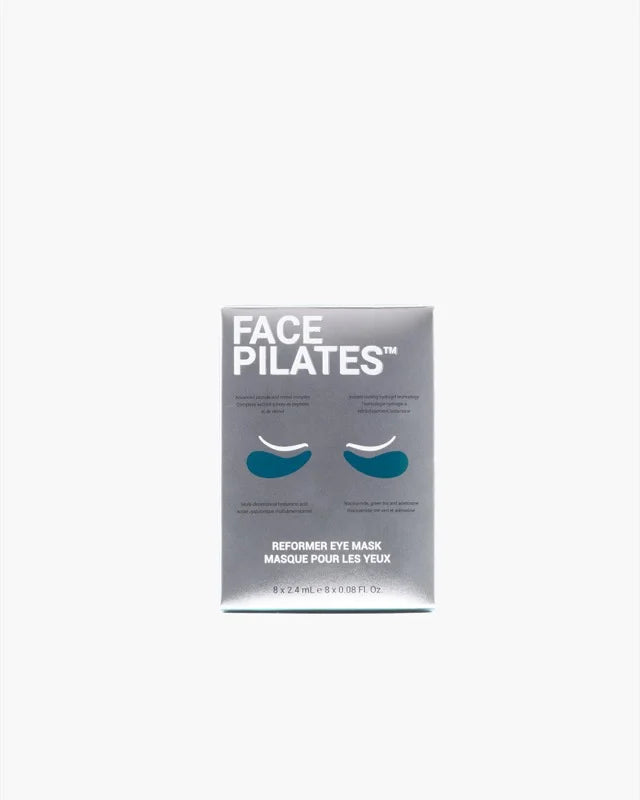
The Reformer Under-Eye Mask answers the same hallmark in thinner skin. Hydrolyzed collagen contributes small peptide fragments that act as humectants and matrikine-style signals. Retinol is among the most thoroughly researched topical ingredients for the look of firmness, acting on nuclear receptors that regulate renewal genes while moderating collagen-degrading enzymes. SYN-AKE and Argireline work a step away from the matrix — on the repetitive micro-contractions that fatigue the delicate collagen of the under-eye over time.
In the studioControlled massage applies mechanical load to the dermis, and fibroblasts are mechanically responsive cells — load is one of the signals that prompts them to build. Microcurrent and red LED are used in the Face Pilates treatment for the same reason: to give the matrix-building cells a reason to work.
Where the Reformer Under-Eye Mask works at the level of the cell, the Face Pilates method works at the level of the architecture.
Tissue stiffening, fascial adhesions and muscle atrophy
Ageing is not only what happens inside skin cells — it is the tissue architecture itself. Facial muscles weaken and lose tone over time. The connective tissue, or fascia, that organises the face develops stiffness and adhesions. These structural shifts alter the contours of the face, deepen folds and slow the flow of fluid through the tissue. This is the dimension of ageing that topical products alone were never designed to reach.
The face carries more than forty muscles, roughly twenty of which are the principal muscles of expression. With age they undergo changes much like the rest of the body's musculature: a loss of fast-twitch fibres, a decline in the satellite cells that repair muscle, and less efficient communication at the junction between nerve and muscle. Unlike postural muscles, which are loaded all day, many facial muscles contract only in particular expressions, leaving large parts of them functionally undertrained. At the same time the connective layers — including the superficial musculo-aponeurotic system, or SMAS — develop fibrotic adhesions as collagen fibres cross-link, a process driven in part by an enzyme called lysyl oxidase and by advanced glycation end-products. These adhesions restrict how facial compartments move, slow lymphatic and venous drainage, and create tethering points that draw the overlying skin into fixed folds. It is a description, in physiological language, of why an ageing face can look not only looser but somehow more set.
In the Reformer Face Mask
Creatine NAD+ Caffeine
The Face Mask supports the recovery side of this work. Creatine is the body's rapid-recharge system for muscle energy, holding a reserve of high-energy phosphate; NAD+ feeds the enzymes that govern mitochondrial upkeep in muscle and dermal cells alike; and caffeine encourages local circulation, helping carry oxygen and nutrients to tissue worked through manual therapy. The Reformer Face Mask is best understood here as the recovery companion to structural work, not a substitute for it.
In the Reformer Under-Eye Mask
SYN-AKE Peptide Argireline
The eye area is in near-constant motion — the average adult blinks well over ten thousand times a day. SYN-AKE (Dipeptide Diaminobutyroyl Benzylamide Diacetate) is a synthetic peptide developed to mimic Waglerin-1, a peptide from the venom of the temple viper; it acts as a competitive antagonist at the muscular acetylcholine receptor, easing the amplitude of those micro-contractions. Argireline mimics part of the SNAP-25 protein and competes with the assembly of the SNARE complex, which can modestly soften expression-driven movement. Both effects are partial and reversible — a gentler register than a clinical procedure.
In the studio — the core of the methodThis is the dimension for which the Face Pilates treatment was built. A yoga-ball warm-up lengthens muscle and connective tissue under controlled tension, much like the warm-up phase of any resistance session. Deep facial and buccal massage — worked both externally and from inside the mouth — reaches the deeper layers of the SMAS and the muscles of the jaw and cheek that no topical product can address. Gua sha and cupping apply shear and negative pressure to restore glide between fascial layers. Microcurrent prompts the facial muscles to contract, functioning as resistance training for an undertrained group. It is, in the most literal sense, Pilates for the architecture of the face.
At a glance
| Hallmark | Reformer Face Mask | Reformer Under-Eye Mask |
|---|---|---|
| Loss of proteostasis (collagen & elastin) | Palmitoyl Pentapeptide-4, Centella Asiatica, Ammonium Glycyrrhizate | Hydrolyzed Collagen, Retinol, SYN-AKE, Argireline |
| Stiffening, fascial adhesions & muscle atrophy | Creatine, NAD+, Caffeine | SYN-AKE, Argireline |
The Reformer Routine
Structure responds to two kinds of attention: the right ingredients, and the right movement. The Reformer Face Mask carries peptides and Centella asiatica studied for the look of firmness; the Reformer Under-Eye Mask brings hydrolyzed collagen, retinol and SYN-AKE peptide to the most mobile skin on the face. Used together, and alongside the facial exercises that give the method its name, they form a single routine for the architecture of the face.
Questions readers ask
Can a topical product really rebuild collagen?
No product simply replaces lost collagen. What well-studied ingredients such as retinol and certain peptides are researched for is supporting the skin's own renewal signals, so the skin looks firmer and smoother over time. We think it is fair to describe that as support, not reconstruction.
Why does the Face Pilates method work the muscles at all?
Because much of what reads as a sagging face is also a question of muscle tone and fascial mobility — layers that sit beneath the skin and beneath the reach of any cream. Working them is the reasoning behind the treatment's massage, microcurrent and gua sha.
Is elastin loss reversible?
Largely not. Elastin is laid down mostly before adulthood and the body makes very little new functional elastin afterwards. This is one reason firmness is best protected early and supported steadily, rather than expected to return in full.
What does SYN-AKE peptide actually do?
SYN-AKE is a synthetic peptide modelled on a molecule found in snake venom. It eases the small, repeated muscle contractions behind expression lines by acting at the acetylcholine receptor. Its effect is partial and reversible — it is the hero ingredient of the Under-Eye Mask, not a substitute for a clinical procedure.
Do the masks replace the in-studio treatment?
They are complete products on their own, and they are also the treatment medium used during the Face Pilates treatment at Aman Spa. The masks address the formulation layer; the treatment adds the structural, hands-on layer. Each is worthwhile alone, and they are designed to reinforce one another.
The interior of the cell, and now the architecture beneath the skin. The final article in this series turns to the surface itself and the systems that keep it alive — the low-grade inflammation that quietly accelerates ageing, the moisture barrier that holds everything in, and the circulation that delivers what skin needs and carries away what it does not. It is the layer you actually see in the mirror, and the one that responds the fastest.
A note on languageThis article is educational. The Face Pilates Reformer masks are cosmetic products; the research described here concerns the ingredients and biological processes themselves, and is not a claim that any product treats, prevents or alters a medical condition or bodily function.
Selected references:
- Shuster S, Black MM, McVitie E. The influence of age and sex on skin thickness, skin collagen and density. British Journal of Dermatology, 1975. pubmed.ncbi.nlm.nih.gov/1220811
- Elastin and the ageing dermis — review. Frontiers in Cell and Developmental Biology, 2021. frontiersin.org
- Centella asiatica in skin: asiaticoside, madecassoside and collagen synthesis — review. pmc.ncbi.nlm.nih.gov/articles/PMC9983323
- Acetyl hexapeptide-8 (Argireline) and the SNARE complex. pmc.ncbi.nlm.nih.gov/articles/PMC4747634
- Anatomy, head and neck: facial muscles. StatPearls / NCBI Bookshelf. ncbi.nlm.nih.gov/books/NBK493209
