


The Science Of Skin Aging — Part One Of Three
Most of what we recognise as ageing skin — the loss of firmness, the slack and the shadow, the dullness that no light seems to lift — begins as something we cannot see at all: a change inside the cell itself. This article, the first in a three-part series, follows three of those interior changes. The slow fall in cellular energy. The quiet erosion of the protective caps on our DNA. And the drift, across decades, in which genes a skin cell still chooses to read. Each is explained first in plain language, then in greater depth, and each is followed by the specific ingredients in the Face Pilates Reformer Face Mask and Reformer Under-Eye Mask that researchers have studied in connection with it.
Biologists who study ageing have spent two decades converging on a shorter list: a set of recognised hallmarks, cellular processes that together drive the visible decline of every tissue, skin included. They are less a set of separate problems than one long cascade, and the earliest links in that cascade sit deep within the cell. What follows is an honest account of three of them — honest in the sense that where the science is strong we say so plainly, and where a popular claim does not survive scrutiny, we have set it aside rather than repeat it.
Declining cellular energy
Think of a skin cell as a small athlete. Everything it does — repairing damage, building collagen, renewing the barrier — runs on energy. As the years pass, that energy supply falls, and a cell that cannot afford to repair itself simply does less. This is one of the most upstream changes in skin ageing: slow it, and a good deal of what follows slows with it.
The cell's energy currency is ATP, produced largely within the mitochondria. Driving that production is a coenzyme called NAD+ (nicotinamide adenine dinucleotide), which also fuels the sirtuins — a family of enzymes closely associated with cellular repair and longevity. Research that has measured NAD+ directly in human skin finds that its levels fall strongly and progressively with age; skin shows one of the steepest declines of any tissue yet studied. As NAD+ grows scarce, ATP synthesis slows, sirtuin and DNA-repair activity is constrained, and worn-out mitochondria accumulate faster than the cell can clear them. In dermal fibroblasts and keratinocytes this reads, over time, as slower renewal and a less resilient barrier. Creatine plays a complementary part: it is the body's own rapid-recharge system, holding a reserve of high-energy phosphate that regenerates ATP the moment demand spikes.
In the Reformer Face Mask
NAD+ NMN Creatine
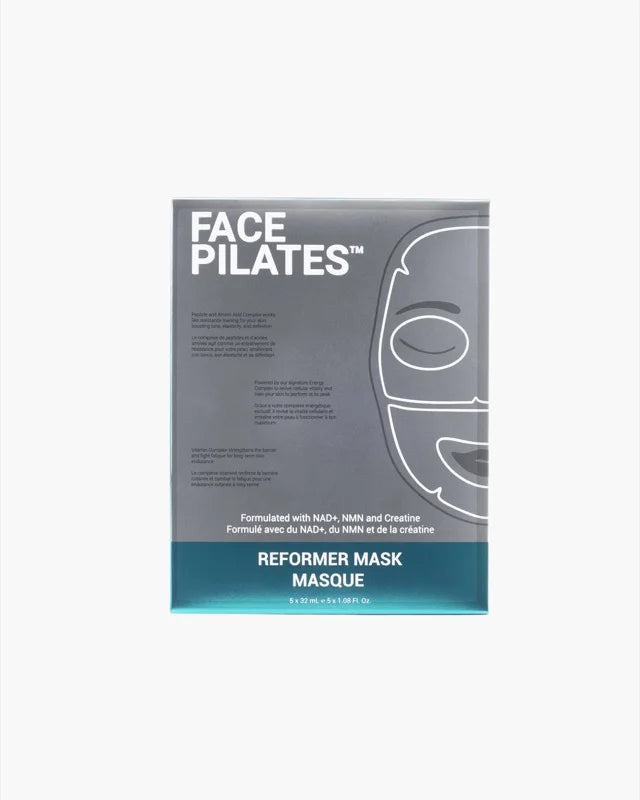
The Reformer Face Mask is built around these three molecules — its Cellular Energy & Longevity Complex. NAD+ sits at the centre of the energy story above; NMN (nicotinamide mononucleotide) is its direct precursor, the smaller molecule a cell can convert into NAD+. Because NMN is comparatively small, the question of how well such molecules travel through skin is an active and still-emerging field of laboratory research — a point worth stating rather than glossing over. Creatine completes the trio as the formula's rapid-recharge element.
In the Reformer Under-Eye Mask
Adenosine
The periorbital area runs on the same energy economy, in thinner and harder-working tissue. The Reformer Under-Eye Mask contributes adenosine — a purine nucleoside that is itself a building block of ATP, and one of the most established actives in eye care. South Korea's regulator formally recognises it as an anti-wrinkle functional ingredient; in the under-eye zone it is valued for visibly softening the look of fine, expression-related lines.
In the studioThe Face Pilates treatment at Aman Spa pairs the masks with red and near-infrared LED and microcurrent. Light in roughly the 600–850 nm range is absorbed by cytochrome c oxidase in the mitochondria — the same enzyme at the end of the energy chain described above — and is studied for its support of ATP production within the skin.
Cellular energy is not a finishing touch in the Reformer Face Mask. It is the foundation the rest of the formula is built upon.
Telomere shortening
Each time a skin cell divides to repair or replace itself, the protective caps on the ends of its chromosomes — the telomeres — grow a little shorter. Once they erode past a certain point, the cell retires: it stops dividing, and begins, quietly, to release signals that irritate its healthy neighbours. Protecting telomere length has become one of the central ideas in the science of ageing.
Telomeres are repetitive stretches of DNA — the sequence TTAGGG, written over and over — that act as a replicative clock. With each division a cell loses roughly 50 to 200 base pairs of telomere, a loss accelerated by oxidative stress, to which telomeric DNA is especially vulnerable. When a telomere falls below a critical length, the cell engages its DNA-damage response and enters senescence. Senescent fibroblasts and keratinocytes then adopt what is called a senescence-associated secretory phenotype, releasing inflammatory signals and matrix-degrading enzymes that age the cells around them. There is a thread running back to the first hallmark here: the NAD+-dependent sirtuins SIRT1 and SIRT6 have been shown, in laboratory studies, to help maintain telomeric chromatin — which connects NAD+ availability to telomere integrity.
In the Reformer Face Mask
NAD+ NMN Vitamin C (Magnesium Ascorbyl Phosphate) Ectoin
Alongside NAD+ and NMN, the Face Mask carries two ingredients chosen for the oxidative side of this story. Magnesium ascorbyl phosphate is a stable, gentle form of vitamin C — an antioxidant that helps neutralise the reactive molecules that wear on telomeric DNA. Ectoin, an osmolyte first identified in micro-organisms that survive extreme environments, behaves as a cellular stress-protectant, helping cells hold their structure against heat, dryness and oxidative challenge.
In the Reformer Under-Eye Mask
Green Tea Extract Rosehip Extract Grapefruit Extract
The Under-Eye Mask takes a botanical route to the same goal. Camellia sinensis (green tea) leaf, Rosa canina (rosehip) fruit and Citrus paradisi (grapefruit) fruit extracts supply polyphenols and naturally occurring vitamin C — antioxidants that help lower the oxidative burden on the thin, mobile skin around the eye, where mechanical stress from a lifetime of expression is unavoidable.
In the studioLymphatic work — by hand, gua sha and cupping — helps clear inflammatory mediators and cellular waste from the tissue, which in turn helps quiet the irritating signals that senescent cells send to their neighbours.
Epigenetic drift
Your DNA does not really change as you age. What changes is which parts of it are read. Over the years the cell's system of bookmarks and switches slips, and skin cells gradually lose the settings that let them behave like young, healthy cells. Slowing this drift is one of the genuine frontiers of longevity science.
Epigenetics is the layer of regulation that sits above the genetic code: patterns of DNA methylation and histone modification that decide which genes a cell expresses. These patterns shift with age in a way so consistent that researchers can now estimate biological age from them — the basis of the “epigenetic clock” first formalised by Steve Horvath. In skin, the drift tends to quiet the genes of renewal and repair while allowing inflammatory genes to speak more freely. Here again the sirtuins matter: SIRT1, SIRT6 and SIRT7 are NAD+-dependent enzymes that help keep chromatin correctly organised, and their activity rises and falls with the cell's NAD+ supply.
In the Reformer Face Mask
NAD+ NMN Ectoin
By supplying NAD+ and its precursor NMN, the Face Mask is formulated around the cofactor on which the sirtuins depend — the enzymes most associated with orderly gene regulation. Ectoin contributes by helping stabilise cellular structures through periods of environmental stress, when epigenetic regulation is most easily disturbed.
In the Reformer Under-Eye Mask
Retinol Niacinamide
The Under-Eye Mask approaches this hallmark through two of the best-studied actives in skincare. Retinol acts on the nuclear retinoic-acid receptors — proteins that directly govern the transcription of genes for renewal and repair. Niacinamide, a form of vitamin B3, is converted by the cell into NAD+ through its salvage pathway, supporting the very same NAD+-dependent enzymes described above.
In the studioChronic muscular tension in the face — from habitual expression, jaw clenching and posture — sustains a low hum of stress and inflammatory signalling thought to hasten epigenetic drift. The deep release and buccal massage of the Face Pilates treatment are aimed squarely at that tension.
At a glance
| Hallmark | Reformer Face Mask | Reformer Under-Eye Mask |
|---|---|---|
| Declining cellular energy | NAD+, NMN, Creatine | Adenosine |
| Telomere shortening | NAD+, NMN, Vitamin C, Ectoin | Green tea, Rosehip, Grapefruit |
| Epigenetic drift | NAD+, NMN, Ectoin | Retinol, Niacinamide |
The Reformer Collection
The Reformer Face Mask and Reformer Under-Eye Mask were formulated as a pair. The face mask is a biocellulose sheet built around the Cellular Energy & Longevity Complex — NAD+, NMN and creatine. The under-eye mask is a hydrogel built around a different strategy: SYN-AKE peptide, retinol, niacinamide and hyaluronic acid. They address different zones of the face with different formulations, and many people use them as a single, considered routine.
Questions readers ask
What is NAD+, and why does it matter for skin?
NAD+ is a coenzyme that every cell uses to turn nutrients into usable energy and to run its repair enzymes. Research measuring it in human skin shows it declines steadily with age, which is why it has become a focus of longevity-minded skincare.
Can NAD+ or NMN really be delivered through the skin?
The honest answer is that this is an active area of research rather than a settled one. NAD+ itself is a large molecule and not an easy skin penetrant; NMN is smaller, and laboratory studies of its delivery are encouraging but still emerging. The Reformer Face Mask is formulated with both, and we prefer to describe that evidence accurately rather than overstate it.
Is the Reformer Face Mask the same formula as the Under-Eye Mask?
No — they are deliberately different. The Face Mask is a biocellulose sheet built around the Cellular Energy & Longevity Complex (NAD+, NMN, creatine). The Under-Eye Mask is a hydrogel built around SYN-AKE peptide, retinol, niacinamide and hyaluronic acid. They are designed to complement one another, not to duplicate.
What is the “epigenetic clock”?
It is a way of estimating biological age from chemical marks on DNA that change predictably over time. It does not measure skincare results — but it is the reason epigenetic drift is taken seriously as a hallmark of ageing.
Do I need the in-studio treatment for the masks to be worthwhile?
No. The masks are complete skincare products in their own right. The Face Pilates treatment at Aman Spa adds manual and technology-assisted techniques — the two simply share a philosophy.
Energy, telomeres and epigenetic settings are the cell's interior. The next article in this series steps outward — to the scaffolding that gives a face its shape: collagen and elastin, the connective tissue beneath the skin, and the facial muscles themselves. It is the part of ageing that creams alone were never designed to reach, and the part where Face Pilates began.
A note on languageThis article is educational. The Face Pilates Reformer masks are cosmetic products; the research described here concerns the ingredients and biological processes themselves, and is not a claim that any product treats, prevents or alters a medical condition or bodily function.
Selected references:
- Massudi H, et al. Age-associated changes in oxidative stress and NAD+ metabolism in human tissue. PLOS ONE, 2012. pmc.ncbi.nlm.nih.gov/articles/PMC3407129
- NAD+ metabolism in skin ageing — review. pmc.ncbi.nlm.nih.gov/articles/PMC8747183
- Hamblin MR. Mechanisms of photobiomodulation. pmc.ncbi.nlm.nih.gov/articles/PMC5844808
- Telomere biology and ageing — review. Frontiers in Genetics, 2020. frontiersin.org
- SIRT1 and telomere maintenance. pmc.ncbi.nlm.nih.gov/articles/PMC3010065
- Horvath S. DNA methylation age of human tissues and cell types. Genome Biology, 2013. genomebiology.biomedcentral.com
- Niacinamide and NAD+ metabolism — review. pmc.ncbi.nlm.nih.gov/articles/PMC7438969
