

Biocellulose, K-Beauty, and the Long History of the Sheet Mask
How a beauty ritual that originated in East Asia became a global standard — and where the Reformer Mask sits inside that lineage, with credit and clarity.
The sheet mask is one of the most successful cultural exports of the last twenty years. It originated in South Korea in the early two thousands, spread through Japan, China, and Southeast Asia, then crossed to North America and Europe as the K-beauty wave of the mid-twenty-tens. This article tells that story honestly, locates the development of biocellulose inside it, and explains where the Reformer Mask by Face Pilates™ sits — as a Toronto-built product that owes its substrate, its philosophy, and its ritual to an East Asian inheritance that deserves credit.
The Korean origin and the first sheet masks
The modern sheet mask is generally credited to Korean cosmetic developers of the early two thousands, building on a Japanese tradition of fabric facial wraps that itself reaches back centuries. The earliest mass-market sheet masks were cotton non-woven substrates saturated in serum, sold inexpensively, and consumed in volume — Korean adults remain the highest per-capita users of sheet masks globally. The cultural logic that produced this market is worth naming: a beauty culture that valued daily ritual over occasional treatment, the social acceptance of low-cost mass-market beauty products, and a Korean cosmetic industry that invested aggressively in formulation research long before Western brands caught up. Brands such as Innisfree, TonyMoly, Mediheal, and SK-II all participated in that build-out.
The biocellulose breakthrough
Biocellulose, the substrate of the Reformer Mask, was not invented in cosmetics. It was developed for clinical wound care in the nineteen-eighties as an artificial skin for severe burns and chronic ulcers. Korean and Japanese cosmetic chemists were among the first to bring the material into beauty applications, identifying its capacity to conform to facial contour and to hold its hydration for the duration of wear. By the mid twenty-tens, biocellulose sheet masks were a premium tier within the Korean and Japanese cosmetic markets, and dermatologists in Seoul and Tokyo had begun using them as post-procedure cooling and barrier-support steps after lasers and microneedling. The North American clinical adoption that followed was, in effect, a Western catch-up.
The Reformer Mask is a Toronto product, but it is not a Toronto invention.
What the Reformer Mask owes, and what it formalises
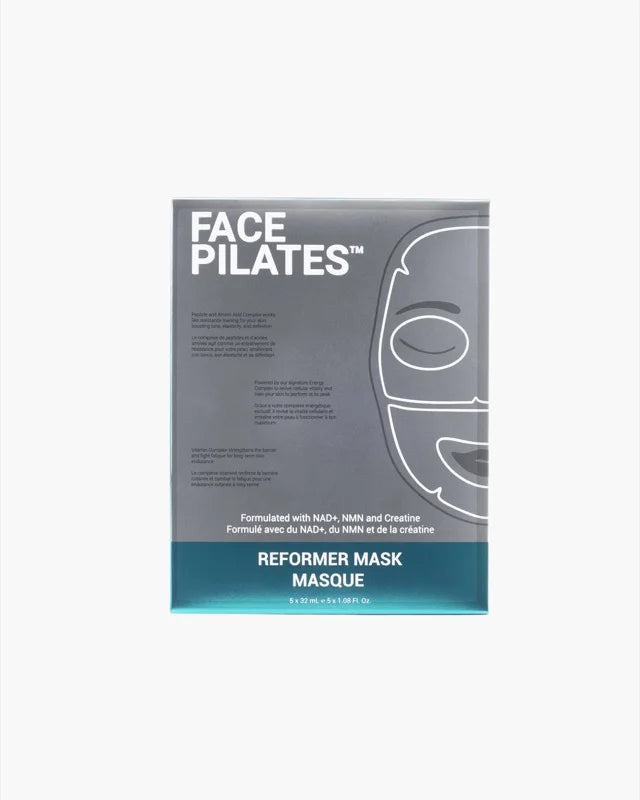
The Reformer Mask is a Toronto product, but it is not a Toronto invention. The substrate is the product of East Asian biotechnology that drew on European clinical research. The fifteen-minute ritual is Korean in origin. The serum's humectant profile — glycerin, betaine, trehalose, sodium hyaluronate, panthenol — is a synthesis of the actives that K-beauty formulators tested at scale across fifteen years. What the Reformer Mask formalises is the integration of this substrate into a clinician-led treatment protocol, where it sits as the closing step of the eight-step Face Pilates™ method developed by Thomas Tullo, RMT, at AMAN Spa Toronto. The combination — East Asian substrate, North American clinical method, fragrance-free post-procedure formulation — is the brand's contribution. The lineage is the gift of others.
How the Reformer Mask compares to the global sheet-mask market
A short comparison clarifies the position. Mass-market cotton sheet masks — Innisfree, TonyMoly, Mediheal at their entry tier — are inexpensive and effective for casual hydration but do not conform tightly to facial contour and dry within ten to fifteen minutes. Premium hydrogel sheet masks — Dr. Jart+'s Cryo Rubber line, SK-II's Facial Treatment Mask in some variants — sit between cotton and biocellulose in conformance and water retention. Premium biocellulose masks — SkinCeuticals Biocellulose Restorative, Lancôme's biocellulose lines, the Korean luxury house Su:m37° — represent the substrate at its highest expression. The Reformer Mask sits in this last category, in formulation lineage and in clinical post-procedure profile, with the distinction of being built for and inside a working Toronto clinic.
What to pair the Reformer Mask with, drawn from the global K-beauty tradition: a niacinamide serum at five to ten per cent (Beauty of Joseon Glow Serum, The Ordinary 10%, Naturium 12%); a snail mucin essence (COSRX Advanced Snail 96, Mizon All-In-One Snail Repair Cream); a Centella asiatica ampoule (Skin1004 Madagascar Centella Ampoule, Purito Centella Green Level); a SPF 50 PA++++ (Beauty of Joseon Relief Sun, Round Lab Birch Juice Moisturizing Sunscreen); and a three-supplement compound — marine collagen, oral hyaluronic acid, astaxanthin — drawn from the same dietary heritage.
Complementary K-beauty products that pair well
For the reader inside the global K-beauty tradition, several complementary formulations pair gracefully with the Reformer Mask. Niacinamide at five to ten per cent supports tone evenness and is particularly relevant for skin recovering from sun exposure. Snail mucin is a humectant and barrier-supportive ingredient with a substantial East Asian cosmetic tradition. Centella asiatica preparations are barrier-soothing and well-evidenced for sensitive skin. None of these contradict the Reformer Mask; all of them sit comfortably in a routine that rotates the mask twice weekly as a finishing step. Korean and Japanese sunscreens of the chemical-filter generation outperform many North American formulations on elegance and texture and are worth seeking out for daily use.
The supplements that compound the ritual
Three supplements have East Asian dietary roots and Western clinical evidence in roughly equal measure. Marine collagen peptides at ten to fifteen grams daily have a substantial randomised-trial base and have been a Japanese dietary staple in the form of nikogori and bone broth for generations. Oral hyaluronic acid at one hundred and twenty to two hundred and forty milligrams daily was first developed as a Japanese supplement and remains a routine over-the-counter product there. Astaxanthin, a carotenoid derived from microalgae and most concentrated in salmon, is the third — six to twelve milligrams daily — with growing evidence for skin elasticity and pigmentation evenness. The lineage of these supplements parallels the lineage of the mask: East Asian innovation, Western validation, now in routine global use.
The history of the sheet mask is a story of East Asian innovation, European clinical research, and now global use. The Reformer Mask by Face Pilates™ sits inside that history with respect, not in spite of it. Built in Toronto by a Registered Massage Therapist trained in manual therapy, formulated to dermatological post-procedure standards, and grown from a substrate developed in Korean and Japanese laboratories, it is a product whose lineage is acknowledged rather than hidden. Use it inside whichever K-beauty routine you already practise. The two traditions belong to the same shelf.
Considered questions
Is the Reformer Mask K-beauty?
It draws its substrate, its ritual, and parts of its formulation from the K-beauty tradition, and the brand acknowledges that lineage explicitly. It is not a Korean product; it is a Toronto product within that lineage.
Where is the biocellulose substrate produced?
The substrate is sourced from biotechnology partners with established expertise in fermented bacterial cellulose; the brand will be publishing a full supply-chain transparency report in due course. Production standards align with cosmetic GMP and are documented at the manufacturer.
Can I layer it with snail mucin or Centella ampoules?
Yes. Apply your snail mucin or Centella ampoule as part of your regular evening routine, on different evenings from the Reformer Mask. On mask evenings, follow the mask with your usual barrier moisturiser only.
Is it more effective than a cotton sheet mask?
For conformance to facial contour, hydration retention through the full wear, and post-procedure-grade ingredient delivery, biocellulose outperforms cotton non-wovens. For casual everyday use, the difference may be less visible.
Does it suit sensitive skin?
The fragrance-free, alcohol-free formulation is intentionally designed for sensitive and post-procedure skin. Patch-test if you are uncertain.
Where is the Reformer Mask manufactured?
The mask is formulated and assembled to Face Pilates™ specifications by manufacturing partners who specialise in biocellulose cosmetic products. Full provenance disclosure is part of the brand's accountability commitment.
Siperstein et al., Journal of Cosmetic Dermatology — Randomized split-face study on biocellulose post-procedure (2024).
Tomonobu R et al. — Astaxanthin for skin: clinical evaluation.
Schunck M et al. — Collagen peptides effect on skin physiology (2015).
COSRX Advanced Snail 96 Mucin Power Essence — leading East Asian humectant essence reference.
