

The Reformer Mask Edit: Why the Most Considered Faces in Toronto Finish with Biocellulose
A guide for the buyer who has built a routine of products that actually work — and is wondering, finally, whether a sheet mask deserves a place in it. Featuring the Reformer Mask by Face Pilates™.
There is a particular kind of skincare buyer who is, by temperament, suspicious of the category. She has spent years assembling a small, deliberate routine of products that perform. New launches arrive at her door rarely, and only when the evidence behind them is verifiable. This guide is written for her. It explains where a sheet mask fits in a considered routine, why the Reformer Mask by Face Pilates™ has become the closing step in the Toronto clinics most rigorous about post-treatment care, and which complementary products and supplements actually compound its effect. No hyperbole, no urgency, only the work.
The shape of a considered routine
The most evidence-driven facial routines are quietly small. In the morning: a gentle cleanser, a topical antioxidant — most often L-ascorbic acid in the ten-to-twenty per cent range, of the SkinCeuticals C E Ferulic class — a barrier moisturiser, and a medical-grade sunscreen of SPF 30 or higher. In the evening: the same cleanser, a prescribed retinoid (tretinoin or adapalene) or its over-the-counter equivalent in retinaldehyde, alternated with a polyhydroxy or lactic acid on the nights between, and a barrier-supporting moisturiser to close. That is seven products, and for the majority of skins, that is enough. Treatments — facials, microcurrent, lasers, microneedling — are layered on top of this foundation periodically. Sheet masks are not a primary treatment; they are a finishing ritual that consolidates the work the rest of the routine performs. Understanding where they sit is the precondition for choosing them well.
What the Reformer Mask actually is
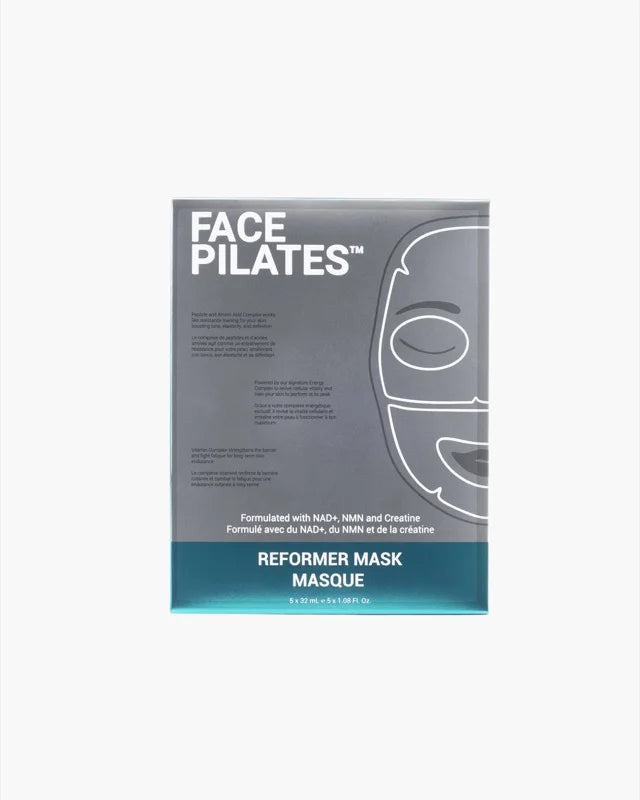
The Reformer Mask is a biocellulose sheet grown from fermented coconut water by bacteria of the Acetobacter and Komagataeibacter genera. The substrate is materially different from cotton or rayon: its nanofibre weave holds water at roughly one hundred times its dry weight, conforms to facial contour by capillary action, and transmits the cool of its serum directly to the skin without textile interruption. The serum is built around five water-soluble actives. Glycerin draws water into the stratum corneum. Betaine, an osmolyte, supports cellular water balance and softens the visual appearance of fine lines. Trehalose preserves the integrity of the lipid barrier under stress. Sodium hyaluronate, the salt form of hyaluronic acid, holds many times its weight in water and produces immediate plumping. Panthenol, also known as provitamin B5, soothes transient redness and supports barrier repair. The formulation is fragrance-free and alcohol-free — the profile dermatologists prefer for post-procedure use, and the profile the most considered buyer prefers for any week.
The most considered routines share three habits: a small number of products chosen for verifiable reasons, a discipline of consistency that compounds across months, and a finishing ritual that closes a treatment rather than starting a new one.
The complementary products that earn a place
A Reformer Mask does not replace anything in the seven-product routine above; it sits alongside it. The products it pairs most usefully with are the ones that share its discipline. A vitamin C antioxidant by morning, ideally L-ascorbic acid stabilised with ferulic acid and vitamin E, performs photoprotective and brightening work the mask cannot. A polypeptide moisturiser — Medik8's Liquid Peptides, Drunk Elephant's Protini, or the comparable formulas from Avène and La Roche-Posay — supports the same barrier the mask hydrates. A medical-grade sunscreen of SPF 50, of the EltaMD UV Clear or La Roche-Posay Anthelios class, is the single most non-negotiable item in the routine and the one most often under-applied. A nightly retinoid, prescribed where possible by a dermatologist, does the long, slow work of stimulating collagen that compounds across months. The Reformer Mask consolidates the visible effect of these products. It does not substitute for any of them.
The supplements that compound results, with restraint
Supplements support skin; they do not replace a working topical routine, and any product that suggests otherwise should be treated with caution. Four supplements have evidence worth taking seriously for the considered buyer. Marine collagen peptides at ten to fifteen grams daily are the most studied: multiple randomised controlled trials report measurable improvements in skin elasticity and hydration across twelve to twenty-four weeks. Hyaluronic acid taken orally at one hundred and twenty to two hundred and forty milligrams daily has a smaller but consistent body of evidence behind it for skin moisture. Omega-3 fatty acids in the form of EPA plus DHA at one to two grams daily are anti-inflammatory and support barrier lipid synthesis. Vitamin D3 at one to two thousand IU daily corrects a deficiency the majority of adults living above the fortieth parallel quietly carry. A fifth, magnesium glycinate at three to four hundred milligrams in the evening, supports sleep — and sleep is the single most consequential variable for visible skin condition that no topical can replicate. None of this is heroic; all of it compounds.
What to pair the Reformer Mask with: a vitamin C antioxidant by morning (SkinCeuticals C E Ferulic or equivalent), a polypeptide moisturiser (Medik8, Drunk Elephant, La Roche-Posay), a medical-grade SPF 50 (EltaMD UV Clear), a prescribed retinoid at night, and a four-supplement stack — marine collagen, oral hyaluronic acid, omega-3 EPA/DHA, vitamin D3 — that compounds the work the rest of the routine performs.
Where the Reformer Mask fits in this routine
Twice a week as a Sunday- and Wednesday-evening ritual is a sustainable rhythm for most skin. The mask is also appropriate after any in-clinic treatment that has worked the skin — microcurrent, gua sha, LED, manual lymphatic drainage, microneedling, fractional laser, or a peel — where the substrate's cooling and barrier-supportive profile consolidates the work just performed. It is the right choice the night before an event, when its plumping and hydration are visible through the next morning. It is not a daily product; the substrate is grown for finishing, not for substitution. Pair it with the seven-product foundation, the four-supplement stack, and the eight to nine hours of sleep that no product can replicate, and the result is the quiet, durable skin that the most considered routines produce.
The most considered routines are not the largest. They are the smallest routines that compound. The Reformer Mask by Face Pilates™ sits inside that small routine as the finishing step that consolidates the rest. Pair it with a verifiable topical routine — vitamin C, retinoid, sunscreen, polypeptide moisturiser — and a restrained supplement stack of collagen, hyaluronic acid, omega-3, and vitamin D3. Then leave the rest of it alone and let consistency do the work.
Considered questions
How often should I use the Reformer Mask in a considered routine?
Twice a week as a Sunday- and Wednesday-evening ritual suits most skin, with additional use the night after an in-clinic treatment or the evening before an event. It is a finishing step, not a daily product.
Does the mask replace my evening moisturiser?
No. After removing the mask, press the residual serum into the skin and follow with your usual barrier moisturiser. The mask is the closing step of the routine, not a replacement for it.
Can I use it after Botox or fillers?
The fragrance-free, alcohol-free formulation is consistent with the post-procedure profile dermatologists recommend. Follow your provider's specific aftercare protocol; typically, masks are appropriate twenty-four to forty-eight hours after injectables.
Is the biocellulose substrate vegan?
Yes. The substrate is fermented from coconut water and contains no animal-derived materials. The serum is also free of animal-derived ingredients.
Which supplements pair best with consistent mask use?
Marine collagen peptides (10–15 g daily), oral hyaluronic acid (120–240 mg daily), omega-3 EPA/DHA (1–2 g daily), and vitamin D3 (1,000–2,000 IU daily) are the four with the most credible evidence. Magnesium glycinate at night supports sleep, which compounds visible skin condition.
Will the Reformer Mask interfere with my retinoid routine?
No. Apply the mask on a clean face in the evening; if retinoid is part of your evening, apply the retinoid after the mask, on dry skin, after a fifteen-minute settle. The mask's barrier-supportive ingredients in fact reduce retinoid-related irritation for many users.
Siperstein et al., Journal of Cosmetic Dermatology — Randomized split-face study on biocellulose post-procedure (2024).
Choi FD et al. — Oral collagen supplementation: a systematic review of dermatological applications (2019).
Calleja-Agius J, Brincat MP — Skin connective tissue and ageing.
EltaMD — UV Clear Broad-Spectrum SPF 46, dermatologist-recommended medical-grade sunscreen.
